NEWS
Micro LED: Beyond Displays to Optical Communications for AI Data Centers
2026. 05. 20
Micro LED: Beyond Displays, Into AI Data Center
Optical Communications
The era
of transmitting data with light is here.
Discover why Micro LED is emerging as
the key light source for next-generation optical communications, and what
technologies are making it possible.
May
2026 | Seoul Semiconductor PR Team | ~4 min read
The era
of transmitting data with light is here.
Discover why Micro LED is emerging as
the key light source for next-generation optical communications, and what
technologies are making it possible.
May
2026 | Seoul Semiconductor PR Team | ~4 min read

What Is Optical Communication?
Optical
communication is a technology that converts electrical signals into light to
transmit data, then restores them back into electrical signals at the receiving
end.
It is dozens of times faster than copper wire and consumes significantly
less power, making it a core infrastructure for AI data centers.
Optical
communication is a technology that converts electrical signals into light to
transmit data, then restores them back into electrical signals at the receiving
end.
It is dozens of times faster than copper wire and consumes significantly
less power, making it a core infrastructure for AI data centers.

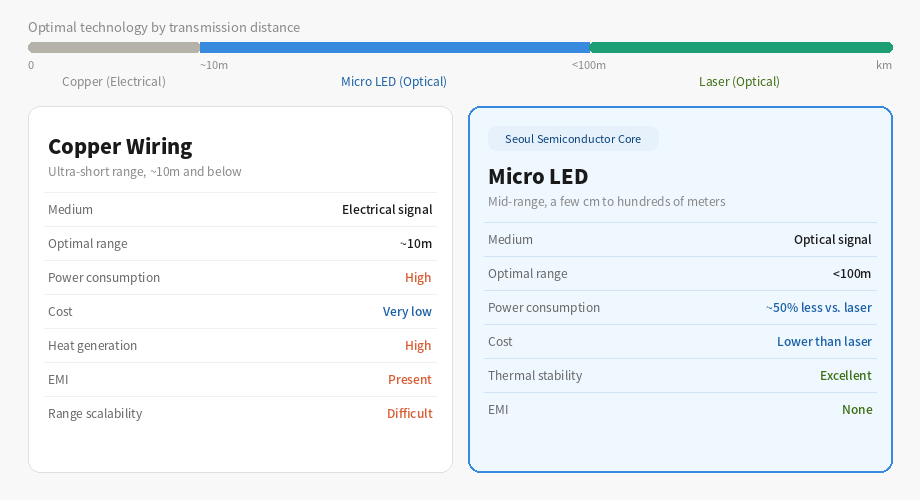
Why Micro LED Instead of Lasers?
Traditional
optical communication has relied on copper and lasers as light sources.
However, as the need to achieve ultra-high bandwidth and low power consumption
required by AI data centers becomes critical, the limitations of copper-based
communication are becoming increasingly apparent.
Micro LED is emerging as a
practical alternative to solve this problem.
Why Micro LED Instead of Lasers?
Traditional
optical communication has relied on copper and lasers as light sources.
However, as the need to achieve ultra-high bandwidth and low power consumption
required by AI data centers becomes critical, the limitations of copper-based
communication are becoming increasingly apparent.
Micro LED is emerging as a
practical alternative to solve this problem.

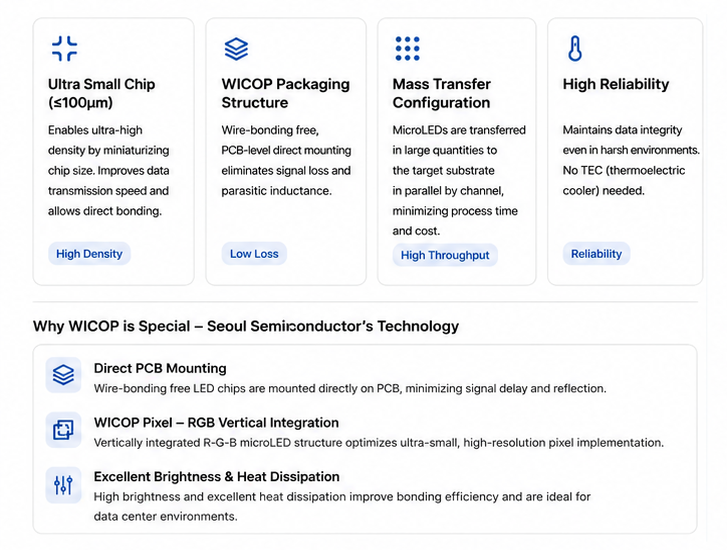
Key Micro LED Technologies for Optical Communication
For
Micro LED to be used in optical communications, ultra-small chip size,
high-speed modulation capability, low divergence angle, and high-density
integration technology are essential.
These four technological elements are at
the core of optical communication applications.
Major Application Areas of Micro LED

#MicroLED
#OpticalCommunication #AIDataCenter #OpticalInterconnect #WICOP
#SeoulSemiconductor #SeoulViosys #Photonics #CPO #NextGenDisplay #Datacom
Key Micro LED Technologies for Optical Communication
For Micro LED to be used in optical communications, ultra-small chip size, high-speed modulation capability, low divergence angle, and high-density integration technology are essential.These four technological elements are at the core of optical communication applications.
Major Application Areas of Micro LED
#MicroLED
#OpticalCommunication #AIDataCenter #OpticalInterconnect #WICOP
#SeoulSemiconductor #SeoulViosys #Photonics #CPO #NextGenDisplay #Datacom