Seoul Viosys Supplies Violeds UV LED Technology for Blood Pathogen Reduction System for the First Time
2026. 10. 27
Seoul Viosys, a leading provider of UV LED solutions and an affiliate of Seoul Semiconductor, announced on November 5, 2020, that it would supply its proprietary Violeds technology to the INTERCEPT Blood System, developed by U.S.-based Cerus Corporation. The technology is intended to reduce the risk of transfusion-transmitted infections by helping inactivate viruses and bacteria in blood components.
At the time of the announcement, Seoul Viosys stated that it was the only company worldwide supplying UV LEDs specifically designed to replace conventional mercury lamps used in blood pathogen reduction equipment. Mercury-containing lamps have raised environmental and health concerns, prompting increasing international restrictions on their use.
According to research cited by the British Blood Transfusion Society, the INTERCEPT Blood System had demonstrated effectiveness against SARS-CoV in August 2005 and MERS-CoV in November 2019. Based on similarities between these coronaviruses and SARS-CoV-2, researchers at the time anticipated that the technology might also be effective against the virus responsible for COVID-19.
Jae-heon Kim, Vice President of the UV Business Division at Seoul Viosys, commented:
“By applying Violeds technology to blood pathogen reduction systems, we aim to provide a mercury-free UV LED solution that contributes to safer blood supplies for patients and healthcare institutions. Given the risks associated with transfusion-transmitted infections, effective pathogen reduction technologies are increasingly important, particularly during outbreaks of infectious diseases.”
Kim added:
“Beyond blood pathogen reduction equipment, we are exploring applications of Violeds technology in hospital operating rooms, surgical instruments, and other healthcare environments requiring disinfection. We have also secured a supply agreement with a U.S.-based manufacturer specializing in MRI medical equipment.”
Cerus Corporation develops and supplies the INTERCEPT Blood System internationally, including in the United States, Europe, and the Middle East. The company's technology has received regulatory authorizations, including CE certification in Europe and U.S. FDA approval for specified platelet and plasma applications.
How the INTERCEPT Blood System Inactivates Pathogens
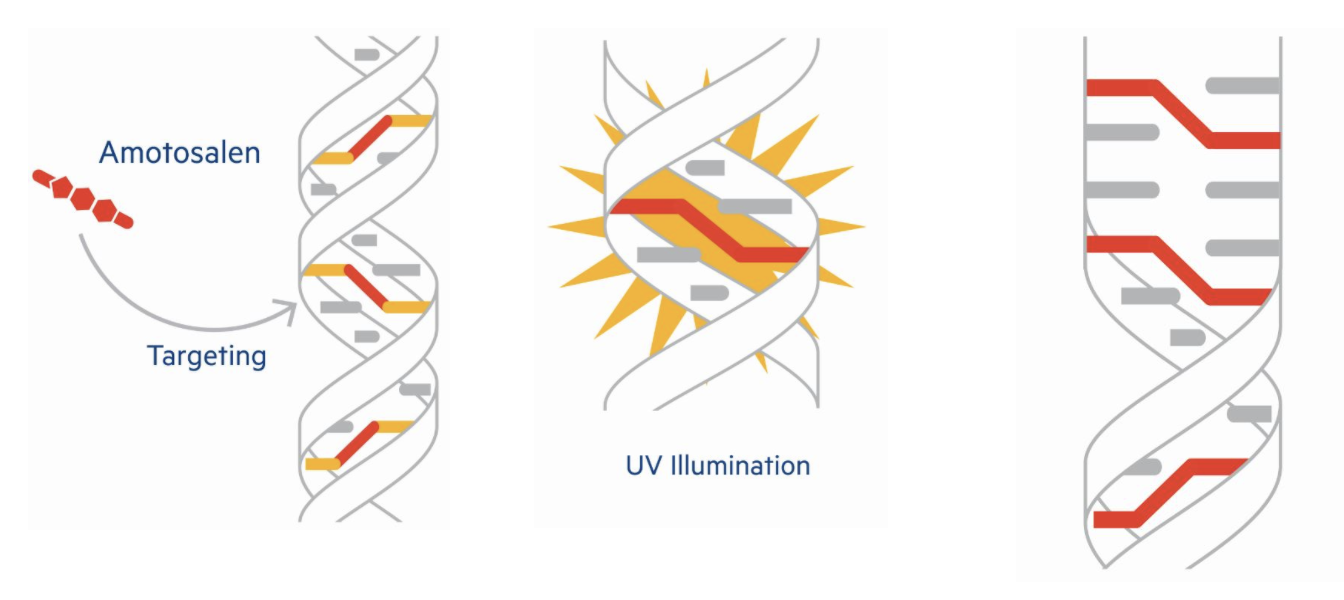
Figure: Mechanism of pathogen inactivation using the INTERCEPT Blood System
Amotosalen targeting: Amotosalen added to blood components binds to the nucleic acids (DNA or RNA) of pathogens, including viruses and bacteria, by inserting itself into their molecular structures.
UVA illumination: Exposure to ultraviolet A (UVA) light activates amotosalen, resulting in permanent cross-links within the nucleic acids.
Pathogen inactivation: These cross-links prevent pathogens from replicating, thereby reducing their ability to cause transfusion-transmitted infections.
About Seoul Viosys
Established in 2002, Seoul Viosys specializes in UV LEDs, VCSEL (Vertical Cavity Surface Emitting Laser) technologies for advanced 3D sensing and laser applications, and Micro Clean Pixel solutions for next-generation displays.
At the time of the original announcement, Seoul Viosys reported a leading global market position in UV LEDs. In collaboration with its affiliate Seoul Semiconductor, the company had developed a broad portfolio of light-emitting semiconductor technologies spanning ultraviolet, visible, and infrared wavelengths from approximately 200 nm to 1,600 nm, supported by a combined patent portfolio of more than 14,000 patents.
Its proprietary Violeds technology uses optimized ultraviolet wavelengths, light intensity, exposure angles, distances, and operating times to support disinfection, air and water purification, pest control, skin-related applications, and plant growth solutions.
In 2018, Seoul Viosys acquired RayCan, expanding its portfolio into advanced VCSEL technologies for facial recognition, autonomous driving, and other sensing applications. In January 2020, it launched Micro Clean Pixel, a single-pixel RGB technology designed for next-generation display applications.
For more information, visit www.seoulviosys.com.